Community Newsletter | Summer 2026 Issue
Chancellor's Message
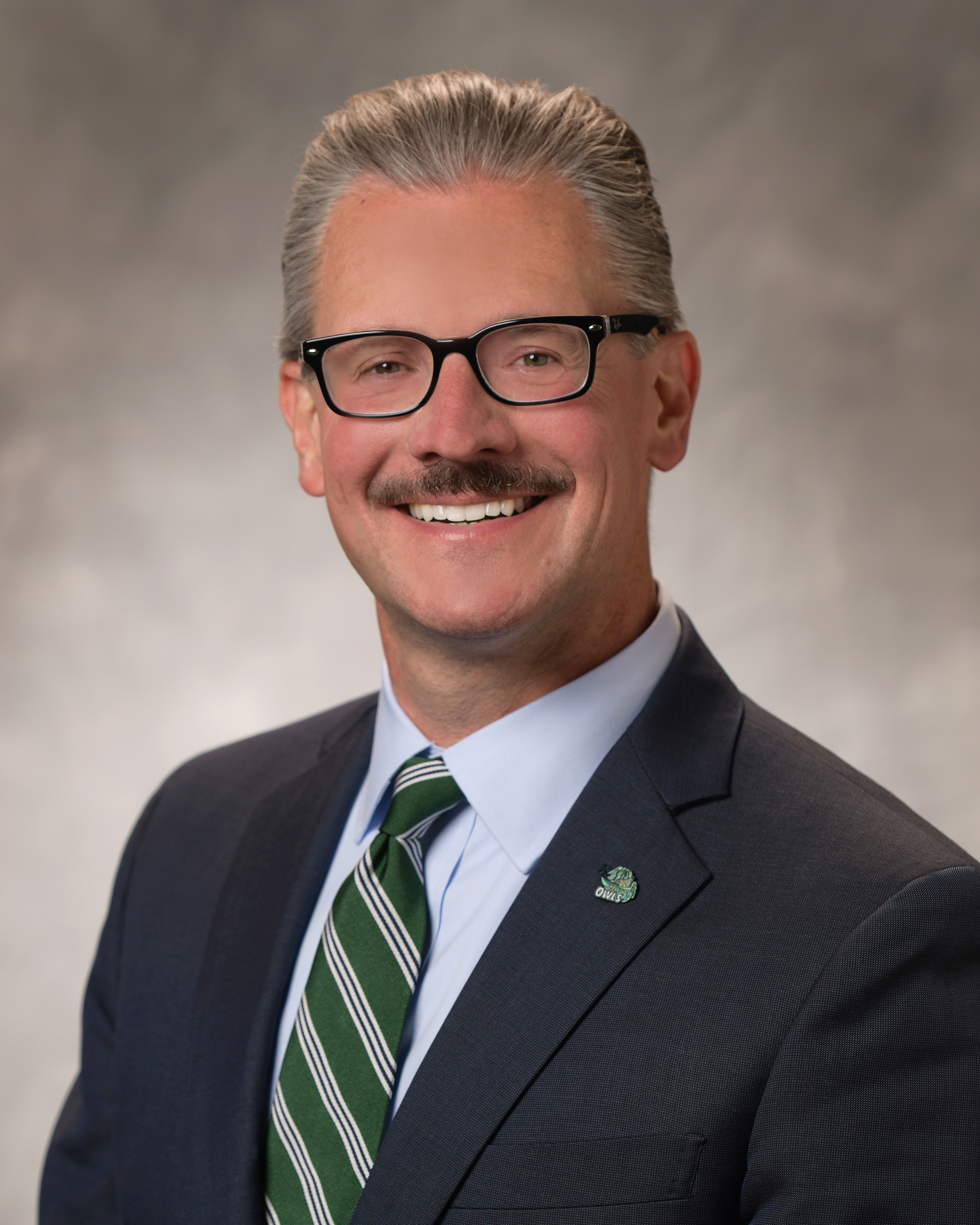
Peter Provenzano Jr.
Our long-term vision for Oakland Community College continues to deliver meaningful results for our students and the community. A key part of this effort is our goal to double the college's graduation rate and help students realize the life benefits of an earned college credential.
We're seeing strong momentum toward that goal. More students are choosing OCC, taking more classes per semester, and completing their programs at higher rates than ever before. These outcomes reaffirm what we have always known: education and workforce training are essential to both individual opportunity and the overall vitality of our region.
In this issue, we highlight one of OCC's most impactful areas: the Emergency Services Academy. Home to Michigan's largest regional police and fire academies, along with the state's only regional K-9 and 911 dispatch academies, these programs set a high standard for excellence. Our Fire Academy remains the only program in Michigan with national and international accreditation. As the new facilities described in this issue become operational, these programs will continue to expand, delivering advanced, real-world training that helps keep our communities safe. In fact, chances are you have an OCC alum serving your community today.
You'll also discover how OCC helps students get a head start on college through programs like Oakland Early College and Dual Enrollment, enabling high school students to earn college credits while preparing for future success.
We also spotlight OCC's libraries—dynamic learning hubs where skilled librarians provide trusted guidance, research support and access to high-quality information.
Together, these stories reflect OCC’s continued growth, innovation and commitment to serving Oakland County and beyond.
Enjoy the issue!
Peter Provenzano Jr.
Scaling Up Safety
OCC invests in the next generation of first responders
Oakland Community College is entering a new era of public safety training—one defined not just by facility expansion but by a broader vision of preparing first responders to best serve their communities.
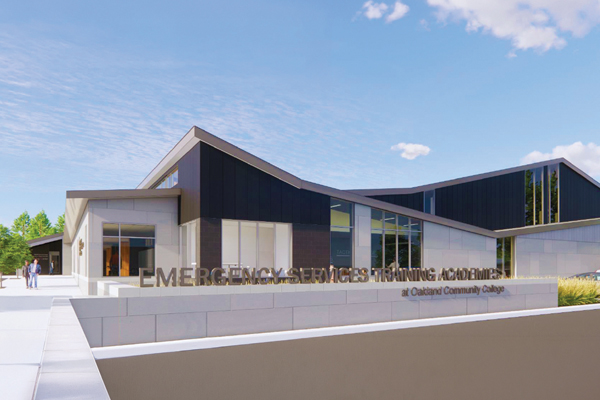
The 65,000-square-foot indoor training facility for OCC’s Emergency Services Program is expected to open in early 2028.
The OCC Emergency Services Academy, the emergency training area formerly known as CREST, has taken a new name that reflects its prominence as the region's largest police and fire academies. It also offers extensive training programs for EMTs and paramedics, 911 dispatchers, police detectives, evidence technicians, K-9 training and more.
For Executive Director of Emergency Services Academies and Dean of Public Services David Ceci, the shift is about more than branding.
"We were looking for something that truly captures the breadth of what we do," Ceci said. "We're no longer centered on one campus. With new facilities and expanded programming, the new name represents all of it."
That growth is most visible at the Auburn Hills campus, where a 65,000-square-foot indoor training facility will transform how students learn. Designed as a fully immersive "indoor city," it will include realistic settings such as a school, office, restaurant and convenience store, complementing the existing outdoor simulated city, which includes homes, a motel, a bank and a five-story fire tower.
Anticipated to begin construction this summer and open in early 2028, the facility will support both basic and advanced training while also serving outside agencies. It will also feature a 15-lane indoor firearms range—five lanes for extended rifle training—along with new classrooms and a computer lab. Such capabilities are rare in the region and even nationwide, offering departments access to more comprehensive and controlled training environments.
At OCC's Southfield campus, a new nine-acre driving pad will provide dedicated space
for emergency vehicle operations training, replacing
the current limited usage of campus parking lots. The facility will allow police,
fire and EMS personnel to safely practice real-world driving scenarios.
"We're modernizing facilities and increasing the vibrancy of underutilized space on our campuses," said OCC Chancellor Peter Provenzano. "The new driving pad will increase the functionality of the Southfield campus like never before."
Together, these developments reflect a growing demand for high-quality training across Oakland County and beyond. Nearly every law enforcement agency in the county has had officers train through the Academy. That reach continues to expand statewide.
For Ceci, the mission remains deeply personal.
"It’s paramount that we produce the best-trained police, fire and EMS personnel possible," he said. "We also truly care about our students and their success because that translates directly to how they serve their communities."
"The takeaway is that we’re investing in the community," Provenzano added. "This program is built for the public benefit, and OCC remains deeply committed to the people it was created to serve."
As the OCC Emergency Services Academy moves forward, its blend of advanced training and community focus is poised to make communities across Oakland County and Michigan safer—one welltrained responder at a time.



OCC Honors Instructor's Heroism
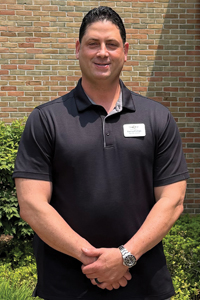
Danny Phillips
Oakland Community College extends its sincere gratitude to Danny Phillips, a Lead Instructor at OCC's Police Academy. Phillips also serves as Director of Security for Temple Israel in West Bloomfield.
On March 12, Director Phillips and Temple Israel Officer Jeff James' heroic actions protected the lives of 140 preschool children and staff during a terrorist attack on the synagogue. Under Phillips' experienced leadership, they were vital in stopping the threat. Phillips was the only person injured during the attack. He plans to return to his duties at OCC and Temple Israel following a full recovery.
Phillips joined OCC's Police Academy in 2018, after a 28-year career with the Bloomfield Hills Police Department, where he retired as a lieutenant. At OCC, he has trained nearly 1,000 cadets and in-service officers in firearms and active violence response—experience that proved critical in preventing a mass (or a greater) tragedy.
The entire OCC community wishes Danny a full and swift recovery.
Ready for the Call
OCC prepares future first responders through immersive training and rigorous academics
Oakland Community College's Emergency Services Academy has long been known for preparing first responders. Beyond its high-profile training grounds and simulated environments, the Academy delivers a deeply structured academic program—one of the strongest in the region—and plays a critical role in shaping the next generation of public safety professionals.
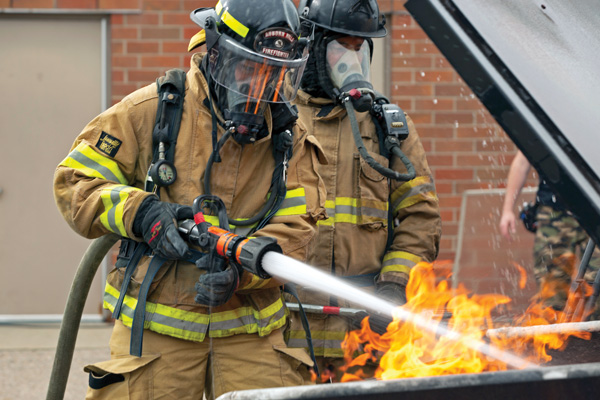
Facilities, real-world training and expert faculty produce graduates who protect communities across Oakland County and the state.
At its core, the Academy centers on three primary pathways: Police (including 911 Dispatch, K-9, and more), Fire, and Emergency Medical Services (including EMT and Paramedic training).
Each program blends rigorous classroom instruction with hands-on experience, ensuring students graduate with both theoretical knowledge and practical skills.
"We really are giving students and agencies the best of both worlds," said David Ceci, Executive Director of Emergency Services Academies and Dean of Public Services. "They receive excellent, high-level instruction in the classroom, and then they’re applying it in realistic environments."
Those environments define the Academy's approach. OCC's training facilities act as simulation labs, where students move beyond lectures into scenario-based learning. Police, Fire and EMS cadets train in a "tactical village" featuring homes, a bank, a convenience store—spaces designed to mirror real-life settings. Fire students also train in a burn tower that uses controlled fuel sources to demonstrate how fire behaves, allowing them to anticipate and respond to dangerous conditions.
"These real-life structures really benefit all three emergency service areas," Ceci
said. "Students
are training in spaces that resemble what they'll face out on the street."
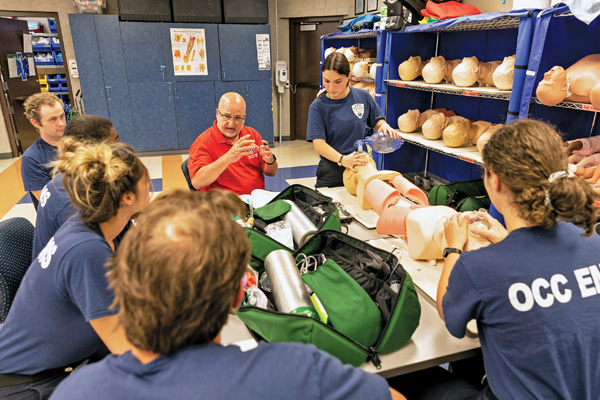
Upon completing OCC programs, students earn certificates and are eligible to sit for state licensing exams.
Technology adds another layer to that experience. The Police Academy uses virtual reality and use-of-force simulators to place students in immersive, high-pressure situations. There, they must make split-second decisions using tools like firearms, pepper spray and batons as well as verbal de-escalation.
While the facilities stand out, OCC Provost Dr. Jolene Chapman said the Academy's academic rigor truly sets it apart.
"The labs simulate real-life scenarios, and that’s very exciting," Chapman said. "And the program is incredibly robust. OCC's Police and Fire Academies award more credits than any other academy in the state. It continues to grow because the need is there."
That academic rigor starts with the faculty. About 170 instructors teach across the Police, Fire and EMS programs, bringing deep, real-world experience into the classroom. Command-level firefighters, law enforcement specialists, prosecutors and subject-matter experts lead courses in everything from crime scene investigation and defense tactics to criminal law and procedures.
"We bring in people who have years of experience on the job as well as fresh talent," Ceci said. "They're specialists in their fields, and they're teaching hundreds of different topics across the academies."
The curriculum extends well beyond basic training. In addition to foundational academies, OCC offers advanced instruction in detective work, evidence technology and specialized investigative techniques for cases such as fraud and sexual assault.
Upon completing the programs, students earn certificates and are eligible to sit for state licensing exams. Police Academy graduates can pursue licensure in Michigan, while EMT and Paramedic students qualify for their respective certification exams. Fire Academy graduates also earn additional credentials, including hazardous materials certification.
Strong outcomes reflect that preparation. The Police Academy boasts 99% completion and licensure pass rates, while the Fire Academy sits in the 90th percentile for both.
"Our academies give students a very strong foundation," Ceci said. "They go on to their agencies and continue to build on those skills by working with experienced professionals."
The Academy's scale also sets it apart.
As one of the largest programs of its kind in Michigan, it draws students from across the state and beyond, including the Upper Peninsula and neighboring states. Some arrive sponsored by local agencies, while others enroll independently, creating a diverse learning environment that reflects the communities they will serve.
That diversity aligns with OCC's broader mission, Chapman said.
"Community colleges serve students with a wide range of goals," she said. "What we offer through the Emergency Services Academy is an opportunity to enter a meaningful career with xcellent preparation."
Equally important is the culture within the Academy—one rooted in professionalism, discipline and service.
"When I walk through the labs with David Ceci, students stop and acknowledge us," Chapman said. "They’re professional, and they understand the seriousness of the work they're preparing for."
For Ceci, that mindset matters as much as technical skill.
"It’s not just about what they can do—it's about how they serve," he said. "We instill care and compassion for the community. That creates better first responders and enhances everyone’s safety."
In the end, that blend of academic rigor, real-world training and experienced instruction defines OCC's Emergency Services Academy and helps protect communities across Oakland County and throughout Michigan.

Community Education
Here is what people are saying about OCC's Community Education classes:
"The course was informative and incorporated fun, hands-on experiences."
The Cultivated Conservationist Course
"I am thankful for learning new ways and opportunities to grow my business through
social media."
Social Media and Content Creation
"The knowledgeable OCC staff shared real-world experiences and taught me fundamentals
that will help me personally and professionally."
CPL Basic Course
"A great way to start a new hobby."
Beginner Crochet Course
Seniors (60 and over) receive a 20% discount on all in-person Community Education courses offered by OCC! Simply enter code OCC60 at registration.
View More Community Education ClassesMarvelous Manners Camp!
This community education class for children ages 8-12 focuses on social skills and manners in an engaging, fun manner.
- When: June 26, 11 a.m. - 1 p.m.
- Where: OCC Orchard Ridge Campus
- Cost: $135 (includes lunch)
Out and About
OCC is where you are—in the community
We invite you to join us at any of the following events:
View all Upcoming EventsJune 13 & 20 | October 3 & 31
Farmington Farmers Market, Downtown FarmingtonSay hello to OCC on select Saturdays at the 33rd annual Farmers Market. Learn more about Community Education, Health Sciences, Admissions, Engineering, Skilled Trades, the Emergency Services Academy and the Culinary Institute.
August 7-9
Milford Memories FestivalLearn more about free tuition opportunities, academic programs, and community education offerings at OCC.
August 11
National Night OutA community-building campaign that promotes police-community partnerships. The OCC Emergency Services Academy and Public Safety Department will feature its driving simulator.
September 4-7
Arts, Beats & Eats, Downtown Royal OakOCC is proud once again to sponsor this event, which celebrates the best in art, music and food in our community.
Beyond the Stacks
OCC Libraries support student success with tools, technology and expertise
For 19 years, Nadja Springer-Ali has helped students discover that OCC Libraries are far more than places to check out books. As a Library Faculty member at the Orchard Ridge campus, she says the college’s libraries play a vital role in helping students succeed—both in the classroom and beyond.
OCC has libraries at the Auburn Hills, Orchard Ridge, Royal Oak and Highland Lakes campuses, along with a student resource room at the Southfield campus. While books remain "the bones of the library," Springer-Ali said the available resources extend far beyond the stacks.
"Students can borrow physical books or access more than 300,000 e-books from home," she said. "They can also access specialized research databases containing scholarly journals, magazine articles and streaming video collections, including documentaries and feature films used in coursework. Each library provides computers, Chromebooks for on-campus use, and a limited number of portable hotspots students can borrow if they need reliable internet access."
The librarians themselves are equally important resources, Springer-Ali added.
"Our focus is information literacy," she said. "We teach students how to refine research topics, navigate library catalogs and databases, evaluate credible sources and properly cite their work. Through workshops, online tutorials, one-on-one research consultations, or our 24/7 Ask A Librarian chat service, we help equip students with skills that transfer to four-year universities—and to everyday life."
The libraries also preserve OCC’s history through the college archives and feature unique collections, including Italian-language books donated to the Royal Oak campus, a Federal Government Documents collection at Orchard Ridge, and a specialized American Welding Society collection at Auburn Hills. As a bonus, Oakland County residents can also use the library resources and check out up to five books.
Whether students are reserving study rooms, borrowing equipment or getting research guidance, Springer-Ali wants them to remember one thing: OCC libraries are ready to support them throughout their entire learning journey.
By the Numbers
A look at OCC Libraries in 2025:
105,000+
Number of visitors.
19,993
Total items circulated.
14,226
Number of reference questions answered.
326,988
Total database retrievals.
6,485
Pieces of equipment checked out.
4,555
Number of students receiving information literacy instruction.
367
Hours the Archivist helped answer OCC historical questions.
Earn Free College Credits Before Graduating High School
Dual Enrollment and Early College programs accelerate student success
High school students can get a head start on college through several tuition-free programs at Oakland Community College that allow them to earn college credit—or even an associate degree—while still in high school.

Gage Pouget
Through Dual Enrollment and Early College programs, students can take online or in-person OCC classes across dozens of subjects, gaining both college credit and early college experience.
"It’s the ultimate way to dip your toe into the water to see what college classes are about," said Jeremy Guc, OCC Executive Director of Admissions and K-12 Partnerships. "Students who participate often have better college outcomes because they've already built that experience. Some graduate high school with an associate degree or are halfway toward earning a bachelor’s degree."
Gage Pouget, who graduated early from Hazel Park High School, began taking Dual Enrollment classes during his junior year.
"My goal was to complete some general education classes before enrolling at a four-year university," he said.
At OCC, Gage completed courses in psychology, math, Spanish, sign language and ceramics.
"Dual Enrollment really prepared me for university classes," he said. "The OCC faculty treated me like a regular college student. I picked up valuable time management and life skills."
Gage plans to study pre-med or pre-dental at a four-year university and is awaiting admissions decisions for fall 2026.

Sofia Juarez Camacho
"I recommend Dual Enrollment for any high school student," he said. "It's a great way to save money while completing college-level classes early."
Sofia Juarez Camacho, a Stony Creek High School student participating in Oakland Technical Early College, is also gaining a head start. During her 13th year, she is studying mechatronics and has earned about 60 college credits.
"I really like building and creating things," she said. "The program has allowed me to get ahead of my peers and open doors."
With help from OCC faculty, Sofia secured an internship with Slater Tools in Clinton Township. After OCC, she plans to attend Michigan State University to study aerospace engineering and hopes to work for NASA as an aerospace welder.
"It's a big commitment, but I highly recommend it," she said. "Work hard and dream big."
Earn College Credits in High School
Early College Program Options
"Traditional" DUAL ENROLLMENT allows students grades 9-12 to take OCC classes that count both toward their high school graduation requirements and as future college degrees/transfer.
Early Colleges are more structured programs in which students take a mix of high school
and OCC courses through 12th grade, followed by a full 13th year at OCC, often finishing
with an associate degree. Options include:
OAKLAND ACE (ACCELERATED COLLEGE EXPERIENCE)
A program run by Oakland Schools where students take a mix of high school and OCC classes in grades 11-12, then attend OCC full-time for a 13th year.
OAKLAND EARLY COLLEGE
Offered through West Bloomfield School District, OEC is a full high school located at the OCC Orchard Ridge Campus. Students take a mix of high school and OCC classes in grades 9-12, with a full 13th year at OCC.
OAKLAND TECHNICAL EARLY COLLEGE
Designed for students pursuing technical careers through Oakland Schools Technical Campuses, students begin taking OCC courses in grades 11-12 and finish with a full-time 13th year at OCC.
In most cases, tuition, fees and books are covered by students' school districts,
making the programs free for participants.

Start Your Someday at OCC
Fall registration is now open!
Now is the perfect time to enroll in classes because "someday" is today.
Register and Start Your Someday!Future Plan
The higher education landscape is evolving. OCC has developed a strategic future plan to enhance our students’ experience and ensure our viability for decades to come.
Learn More About Our Future Plan